Mirko Tobias Schäfer / Assistant Professor
University of Utrecht Department for Media and Culture Studies

Mirko Tobias Schäfer / Assistant Professor
University of Utrecht Department for Media and Culture Studies
1/2 Previous Next
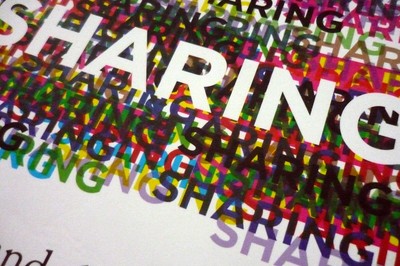
The German Research Foundation network Media of Collective Intelligence invited Philippe Aigrain to present his view on reforming copyright.
Three panelists, Christiane Heibach, Sebastian Haunss and Mirko Tobias Schäfer, were then asked to respond to Aigrains theses. Here is my statement on Aigrain's book Sharing.
Tags copyright File-Sharing Review
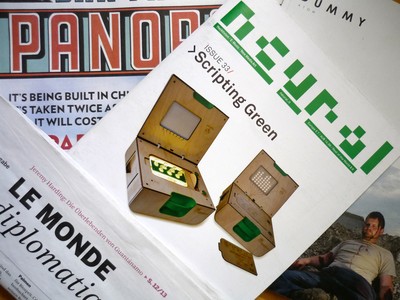
While the new materiality of digitized media content has radically challenged the music and film industry, the publishing industry seemed to feel comfortable neglecting the changing reality of the media business. But then major news papers blamed their decreasing revenues on freely accessible web content, and paint a dark picture of a future lacking proper journalism and diverse media, most ominously, the vanishing of printed papers and magazines. Time for a reality check: It appears that there is not only a demand for print but there are also smart publishers producing innovative print products.
Date August 2008 / Category News

An often recurring motif in many films and stories is a character carrying a bag or a suitcase whose content is rather mysterious, unknown or of shady nature as purloined information, stolen goods or pornography. Inspired by these underworld milieu characters, Nancy Mauro-Flude aka sister0 conceived the performance "Bag Lady 2.0", for which she designed a bag, that is able to record, store and broadcast information in real time. Images can be taken with a camera attached to the bag, a microphone records sounds, even a GPS device can apply geographical data to identify the geographical location of the recorded sites. The functions of the bag can be controlled through a small keyboard attached to the bag. Equipped with that bag sister0 roams through urban spaces to collect images and impressions, that are then transmitted through open WLANs to a server. The bag is not only an item for collecting, but also for broadcasting gathered information in realtime.
Date April 2008 / Category News
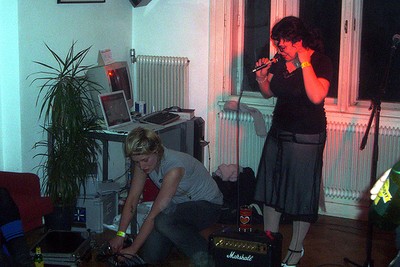
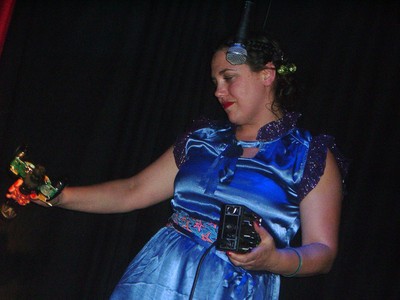
The Viennese Wohnzimmerkonzert featured an evening with MuQua artist in residence Nancy Mauro-Flude, aka Sister0, and London based "pirate, post-postmodernist, rebel and rock star" performer Jesse Darlin'. The concerts literally take place in Costa Caspary's small living room, and as a good host he even provides a buffet and cold beers in his kitchen. The two artists rocked the LabFactory the previous night with Sister0's performance, "My First Burial", and Jesse Darlin''s "I Was A Teenage Porn Star". Tonight was on the whole a fast, fragile and funny performance of songs, poems and some in-between chit-chat; stand-up rock stars forced to low volume. Performing a cappella without microphones, spiced with iconoclastic humour and never taking themselves too seriously, their appearance was an unplugged post-punk version of chamber music for the jilted generation coming of age. Jesse Darlin', subtle and clownish while performing her song "When The Machines Went To Sleep" is evocative of Blade Runner-like replicants. The congenial duo complements one another, as the punk-vaudeville act of Jesse Darlin' provides a constant commentary to Sister0. They draw from a cornucopia of intertextual references to create an indisputable post-ironic winking collage of punk-rock gone coffee party. Subverting any intellectual interpretation the duo manages to literally perform their own commentary and discourse simultaneously in their show.
Beyond Vienna's posh culture venues, limited to an oddly small living room and stripped of sound equipment, Jesse Darlin' and Sister0 remain unquestionably passionate and sovereign artists, convincingly performing straight from the cerebral cortex.
Tags Review
Date March 2007 / Category News
The Wealth of Networks is a very interesting and enjoyable book on the collective production online. Yochai Benkler describes at hand of many examples how collectives of users generate valuable knowledge and a cultural resource. He refers to examples of successful bypassing repressive attempts of the copyright industry or politics. Benkler recognizes the media practice of communities as new ways of organizing citizenship and cultural production. The networks of collectives cause conflicts with the conventional system of civil administration and cultural industries. Benkler's argument is supported by case studies which explain the dynamics of collective production in networks. However Benkler sometimes seems to be quite optimistic about the capability of networks and the usage of technology.
Important is his claim for socio-political responsibility in dealing with the new cultural resources, a global archive and infrastructure, that are shaped by millions of users and that forms a crucial aspect of tomorrow's information society. The weblog Crooked Timber organized a seminar to discuss the book and published their various accounts to Benkler's hypotheses as well as his reply.
Tags Review
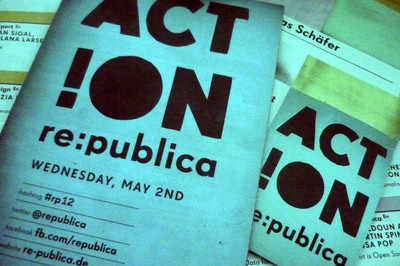
The who is who of the German online world gathers for an annual reunion at re:publica. Since 2007 this convention provides a forum not only to meet face to face, but especially to discuss a broad range of issues concerning internet culture and its implementation into broader society.
Tags conference Review
Date August 2009 / Category News
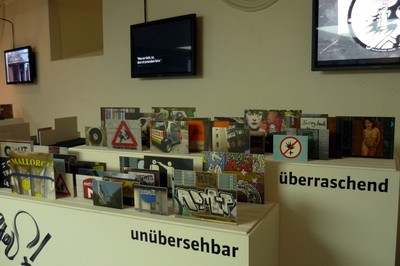
Urban space is characterized by a large numbers of signs, displaying information, channelling traffic, attracting our attention for a variety of means: Memorial tablets, brand logos, billboards, traffic guidance systems, information boards, graffiti, road signs, prohibition signs, and instruction plates constitute an inseparable part of everyday life and shape cultural identity as well as urban environment. With some help of his family Markus Hanzer documented a vast number of signs in urban space, displayed at the Vienna Museumsquartier in an exhibition entitled: Krieg der Zeichen. Spurenlese im urbanen Raum.
Tags Review
Date August 2008 / Category News
While so far Europe's politicians have luckily been unable to install a centrally organized police authority that spies on its citizens and strips them of their citizens rights, the United States has witnessed the emergence of a powerful and frightening authority that threatens to invade all areas of private life and monitor all citizens. The Department for Homeland Security seems to top all Orwellian nightmares.
How unbalanced and unquestioned power, paired with the excessive use of information technology for surveillance and pattern recognition is undermining democracy and constituting repression is described in a timely novel by Cory Doctorow.
Tags Review
The graduation show of the Piet Zwart Institute master program in Media Design takes place at WORM Rotterdam. On Saturady July 7th Florian Cramer, head of the MA Media Design, gives an exclusive tour for the new media master students from Utrecht University. The exhibition covers a wide range of topics, from mash up web sites, over hardware hacking and critical software design to performance.
Piet Zwart Media Design Master, graduation show at WORM
Date March 2007 / Category News
The Gemeentemuseum in The Hague exhibits 'The Sixties' (January 20 - April 30 2007). For visitors not familiar with the dutch contribution to minimal art and concept art the exhibition offers some valuable insight. Unfortunately that is all 'The Sixties' can offer. While there would be many accounts to approach the 1960ies the curators seem not to have chosen one. The 60ies media situation and the media usage in art, activism and politics alone, would have offered an interesting approach to this era and could have been inspiring for reflecting media practice in digital age.
It is rather a collection of stuff that would widely be associated with that particular era, but it would be difficult to recognize an attempt to contextualize the presented objects. Art, fashion, furniture and media clippings are assembled and provoke elder visitors to nostalgic reactions. The displayed film fragments remind of MTV-style video clips and are accompanied by 60ies music. To younger visitors the incoherent collection would rather acknowledge the vague picture of the 'roaring sixties' mainstream media shaped in the blurring rear mirror of presentation. Unfortunately there is little attempt to explain the inconsistencies and socio-political frictions that were so much contributing to the cultural production and social efforts of that time. The dutch Volkskrant says it should have been more emphasized that the drive behind the "little revolution" was not essentially art, but students, hippies and activists who turned against the hypocritical and repressive politics.